Pages

Monday, June 22, 2015

Weekend Roundup: Muhlberger and Savoie

A week of vacation is calling next week so I'm making this an abridged version.

Gregor Mühlberger

...is pretty amazing. In the last month, he won 5 races including the overall of two stage races in the Zavod Miru U23 and now, the Oberösterreichrundfahrt. After going 2nd in the opening 4 kilometer uphill road stage, Mühlberger dropped bombs on Sunday on the stage to Steyr and went on a huge solo run to win the final stage by 1'48" on 2nd place Victor de la Parte. A long, crazy solo breakaway seems to be Mühlberger's specialty.

Just don't go to Sky, Gregor, please.

Tour des Pays de Savoie

My heart just wasn't in this race this year simply because of the lack of a strong U23 field. Yes, there was some good U23s there but when you got older Spanish climbers like David Belda that weighs 53 kilos and climbs like no one's business.

Sam Oomen (Rabobank) was a star and showed that he is a top 10 favorite for Giro della Valle d'Aosta and Tour de l'Avenir. Oomen won stage 2 of the race in a nice breakaway and followed it up with the stage 4 win in the TT to take the yellow jersey into the final stage. It was short lived because the final stage on Sunday saw the miniature Belda take massive time on Oomen. Belda easily took the overall win while Oomen ceded a minute and a half to the Spaniard.

Oomen finished 2nd overall while Jeremy Maison (CC Etupes), who was great in the Ronde de l'Isard, finished 4th overall after a steady race with four straight top 10 stage finishes. Nico Denz (Chambery CF) started the race well but petered out on the final stage to finish up 7th overall. 

Leo Vincent (CC Etupes) did another fantastic final stage performance to take the stage win after taking the final stage in the Ronde de l'Isard. The 19-year old is carving out a slot in the teams for Valle d'Aosta and l'Avenir.

Until next time...

P.S. US U23 Nationals are early this week with the RR on Wednesday, the TT on Friday and the criterium on Sunday. My picks are Alexey Vermeulen for the RR,  Greg Daniel for the TT and Ben Wolfe for the crit.

Friday, June 19, 2015

So Manolo Saiz is starting a U23 team...

to which I say, who really gives a fuck? Not many because where was the sustained outcry when Mr. Saiz joined Spanish amateur outfit Cafes Baque team this year as a consultant? Sustained was the key word there because once people let a few weeks go by, shit goes back to normal. "Oh that Saiz...he needs to get out of cycling," they say before taking a sip of coffee and checking to see who favorited their coffee shop tweet from the other day.

That is the problem. Manolo Saiz facilitated the doping of riders on ONCE and Liberty Seguros. He is one of the people that should never be allowed around a professional cycling team ever again. I do not care how much he says how sorry he is, how he has changed and will lead young riders on the virtuous path. He lost his chance, in my opinion. He should have kept managing his restaurant and kept away from two wheels.

Here is the article from Cyclingnews in question.

Yet he got through part of this season without attracting too much attention. So people might say something here and there next season, if this team even does come about, but that will be the extent of it. Because there are plenty of other riders from the Puerto generation that are still active or in team management now so as long as Saiz apologizes and says that he has turned a new leaf, he will get a free pass. As long as society as a whole is more or less fine with doping or categorizes it as an issue of the past, Saiz will be able to raise the funds to have his own team and the UCI will not stop him.

I hope the team doesn't materialize. Spanish cycling isn't in a good place right now, especially on the development side of things, but brining in some paunchy guy from Cantabria will not help the situation in the least. He is bring with him David Etxebarria and Herminio Diaz Zabala, both of whom rode for ONCE and the former being involved in Operacion Puerto while Zabala was apart of the ONCE Tour team nearly every year. I am struggling to find a positive so far with this team.

Wednesday, June 17, 2015

Weekend Roundup

Tour de Beauce

After finishing this race, Robin Carpenter said that the Tour de Beauce might be one of the hardest races not many have heard of. That is certainly a true statements, especially for those that do not follow the North American circuit.

Without going into an exhaustive analysis of the race, Caja Rural showed everyone what a European team can race like while Hincapie Racing with Toms Skujins and Dion Smith nearly pulled off a coup. Caja Rural put 3 riders in the top 6 overall with Pello Bilbao, Amets Txu-Txu Train and Eduard Prades but they had to wait until the last 2 laps of the last stage to steal the GC from Skujins, who capped off a brilliant two weeks with 2nd overall here.

On the U23 front, Dion Smith was incredibly consistent with 4 finishes in the top 7 on stages along with 3rd overall and overall wins in the points and youth jersey. Smith is good on so many different terrain types that he can score a good GC place in sprint dominated races as well as races with climbs.

Axeon had a good week with 4 in the top 15 led by James Oram in 7th place. Oram did as well as he could but missed a decisive split on stage 2 that would have saw him higher on GC. Keegan Swirbul was the only rider to make that split but he suffered the following day that sank any GC hopes. Greg Daniel was 6th in the TT and Ruben Guerreiro was consistent for 10th overall.

Ben Perry (Silber) had the U23 ride of the week as he got into the final move on the final stage with Pello Bilbao and Rob Britton (Smartstop). Perry had the best sprint on the day and took his biggest ever result with the stage win. His teammate Alex Cataford was 8th in the TT and continues to do well in his comeback season after his horrific training accident in 2014.

Malopolska

The 3-day Polish race saw all of the best Central European continental teams for the race's 53rd edition. Marko Kump dominated the race as he won the first two stages in sprints and while a breakaway got away on the 3rd stage, we won the sprint for 4th.

Stage 2 was the deciding stage when about half of the race abandoned while the front half of the peloton split off and about 25 riders gained 5 minutes on everyone else. Silvio Herklotz missed the split but his teammate Lennard Kamna represented Stolting in the move and went to finish 4th place on the stage. Martin Grøn (Riwal) got the KOM jersey and some bonus seconds from the sprints to vault him him on the GC.

The final stage was Herklotz's revenge as the German got into a breakaway with Adrian Kurek and Sergey Lagkuti. Herklotz took the maximum sprint points to take the sprint jersey and took the maximum mountain points but finished 2nd in the KOM competition to Grøn. While Kurek broke away for the stage win, it was who else but Marko Kump to take 4th place to wrap up the overall.

Marko Kump is in this weird talent level that straddles the continental level and the World Tour. He has won 10 races this season and probably will get near 20 by the end of the season and yet, who knows if he will get a ride on the World Tour level again.


GP Jugendorf

Gregor Muhlberger once again proved how dangerous he is by another long range breakaway to win the GP Jugendorf with a gap of 1'25" back to the chasing group of 4 that included Andi Bajc, Florian Bissinger, Victor de la Parte and teammate and fellow U23 Felix Grossschartner.

The question is now where Muhlberger is headed to for next season. Bora-Argon 18 is a favorite because of their strong German ties as well as Giant-Alpecin for similar reasons. He can time trial, climb, proven himself as a GC threat and as a good one-day rider.  If you somehow haven't heard of him then I have failed at this but you should watch out for him.

Okolo Slovenska

Besides the interesting elimination race prologue that decided the jerseys before the first stage, the Okolo Slovenska (Tour of Slovakia) was a rather mundane affair with 4 sprint stages punctuated by one hillier stage that separated the GC. The only two U23s to make the break were Lorenzo Rota (UniEuro-Wilier) and Oleg Zemlyakov (Vino4Ever) and they ended up 7th and 6th respectively on the final GC, both 21 seconds back on winner Davide Vigano. You would need to go back to 14th overall with Toon Aerts (Telenet-Fidea) to find the next U23 finisher.

GP Sarajevo

To Bosnia with the GP Sarajevo, which turned out to be a contest between three riders pretty quickly. In the end, Slovene Gasper Katrasnik, riding for the now-amateur Sava team, got away from his breakaway mates Sergey Belykh (Itera-Katusha) and Stefan Stefanovic (Keith Mobel-Partizan) to take his first UCI win for his young U23 career. U23s dominated the top 10 win 6 riders.

GP Horsens & Fyn Rundt

Two Danish one-day races dotted the calendar with the GP Horsens & Fyn Rundt.

Horsens sits roughly halfway between Copenhagen and Aarhaus. Horsens was the home of the Glud & Marstrand cycling team that was the predecessor to the CULT Energy team and saw riders such as Michael Valgren, Sebastian Lander, Chris Juul Jensen and more.

Anyways, the GP Horsens was a lumpy race with a lot of short, sharp climbs as well as a nice heaping spoonful of Danish crosswind. Similar to the Skive-Løbet, Alexander Kamp, who is experiencing his best season since the junior ranks, got into the winning breakaway that was fairly spread out between teams. Kamp (ColoQuick) was the strongest after the tough day and out-sprinted Rasmus Guldhammer & Asbjorn Kragh for the win. Other U23s in the leading group include Steffan Christiansen (5th), Magnus Bak Klaris (7th/SEG Racing) and Mads Rahbek (Trefor).

The Fyen Rundt was a much flatter affair as it took place on the isle of Fyen and, more specifically, around the city of Odense. The main action came in the finale when last year's Swedish junior TT champion Hampus Anderberg was out front and with 2 kilometers to go, Andreas Vangstad (Sparbanken Sør) came out of the peloton to try and bridge up to him. He didn't make the connecting until inside the final kilometer but the peloton was breathing down their neck. The only problem was that no one in the peloton wanted to launch the sprint so Vangstad went again. Either with Alexander Kamp and Yoeri Havik going for it, Vangstad held them off to take his 2nd win of the season after his solo win in the Tour of Norway. Kamp was the first U23 in 2nd while Anderberg held on for 4th place.

Italy

Minali and Consonni go 1-2 in Monza (Foto: ItaliaCiclismo)

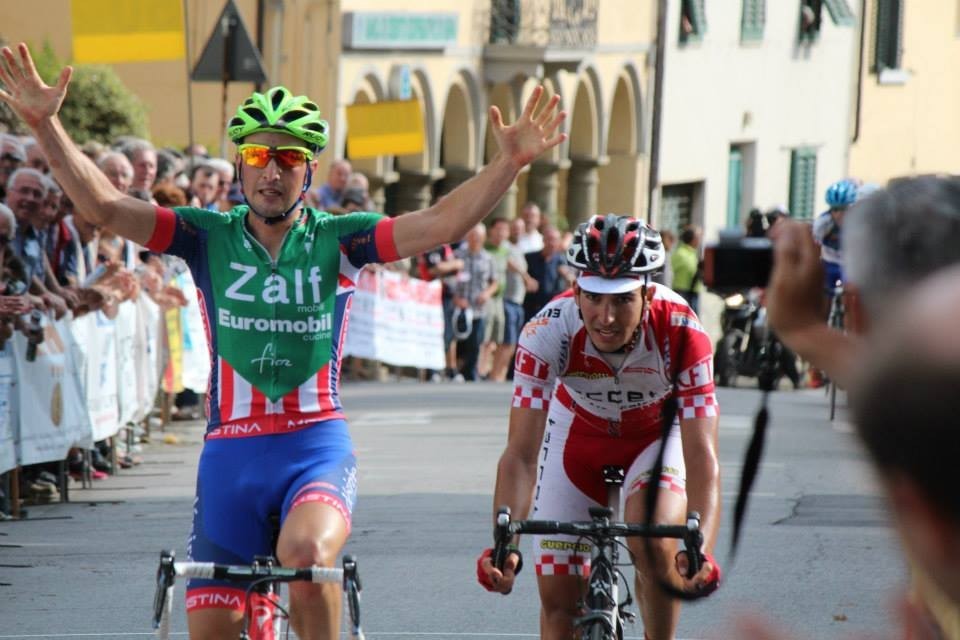
Gianluca Minali takes yet another Zalf-Euromobil win with this in the Trofeo Malmantile
(Foto:ItaliaCiclismo)
Colpack and Zalf-Euromobil continue to win in Italy.

Friday, June 12, 2015

Alexander Kuznetsov: The Soviet Master

As time passes, Russian cycling cannot extricate itself from the era of the Soviet Union. An era that is now more discussed for the doping regiments, the Soviet system was ruthless with training regiments that were meant to select only the riders that could handle it the punishment. This vicious dedication led to a leviathan on the amateur level with Soviet riders taking an incredible amount of wins on the road and track. While news reports of rampant doping in Russian sports and Russian riders popping with nearly as much frequency as Iranian riders, there is an active team manager that was one of the key Soviet coaches that coaches some of the Soviet Union's finest cyclists and has done everything he can for the development of Russian cyclists. His results with riders such as Ekimov, Manakov, Krasnov, Markov, Ignatiev and many other saw him hailed as a national hero and to some, the father of Russian cycling.. Let us find out about the Soviet Master, Alexander Kuznetsov.


Kuznetsov was born in 1941 in the eastern city of Dubrovka in the Bryanska Oblast, which presently sits up against Belarus. Kuznetsov's father was killed just months after he was born on the Eastern Front. Kuznetsov spent the majority of his youth in the Ukrainian town of Nikopol with his aunt where he worked as a turner in a pipe factory and started to become involved in cycling with the factory's team. Kuznetsov raced in his youth with the Dnipropetrovsk region team but at 23, he left for Leningrad (now known as Saint Petersburg) to continue school and started coaching with the voluntary Lokomotiv sports school, which was associated with the October Railway. The school, like the state-sponsored company, was centered in Leningrad and Kuznetsov got support by promising not just to make sports masters but champions.

Tsareva & Kuznetsov
The early years were slim with the majority of results coming from the star female sprinter Galina Tsareva. Tsareva was noticed by Kuznetsov in the mid-60's after some strong regional performances and she agreed to come to Leningrad to join Lokomotiv. At that time, Kuznetsov was still working in a basement with most riders on road bikes instead of being track focused. In 1968, Tsareva won the junior Soviet Union championship in the track sprint after coming in without any praise. The following year, she won the amateur World Championship ahead of the more experienced Galina Ermolaeva (a five-time World Champion at that point) and Irena Kiritchenko. In her first three years, Tsareva was nearly unbeatable with three World Championships in the sprint and multiple Soviet national titles. Their relationship advanced from just coach-rider and turned intimate with the couple wedding on December 30th, 1971 and having their first child, Nikolai, in 1973. Galina would go on to win three more World Championship titles in the Track Sprint from 1977-1979 and over her career that spanned until 1987, hauled in more than 25 Soviet titles across the track and road while having two more kids in Alexei and Svetlana. You might recognize Sventlana as her last name, much like many females in Russia, has an a added on to it to make Kuznetsova. Kuznetsova won the US Open and French Open and while her best days might be behind her, she is still 18th ranked in the world.

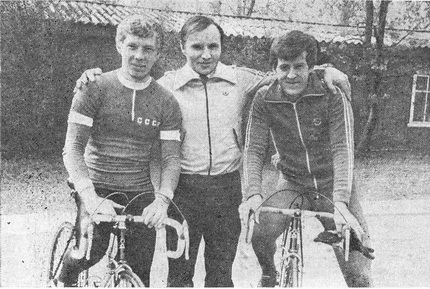
Kuznetsov flanked by two of his star pupils, Krasnov (l) and Manakov (r)

While Kuznetsov's first major triumph was with his wife, his next big coup would be homegrown starting with a crop of riders from the Lokomotiv center in the late 70s including Viktor Manakov, Alexander Krasnov and Ivan Mishchenko. Kuznetsov and his team showed up at the 1978 all-Soviet championships and with a junior squad, they finished 3rd overall behind two teams that were the best senior Soviet men. Kuznetsov's boys pretty much took over the Soviet team pursuit team for the 1980 Moscow Olympics with Krasnov, Manakov and Vladimir Osokin, who became interested in cycling under Kuznetsov as a teen, were all selected. While the boycott took away some competition, the Soviets clocked an Olympic record time in the quarterfinals of 4'14" and then proceeded to dismantle the East Germany team to win the Olympic title. Krasnov and Manakov became cornerstones of the Soviet system for the rest of the decade while Kuznetsov would rise to the head of the Soviet cycling system along with the emergence of his biggest talent.

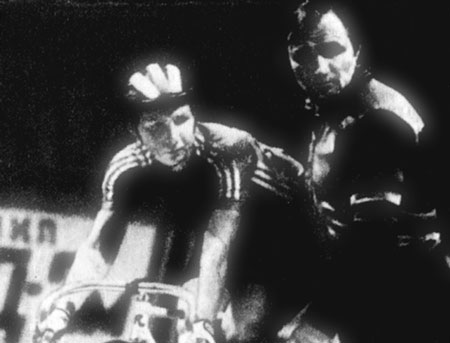
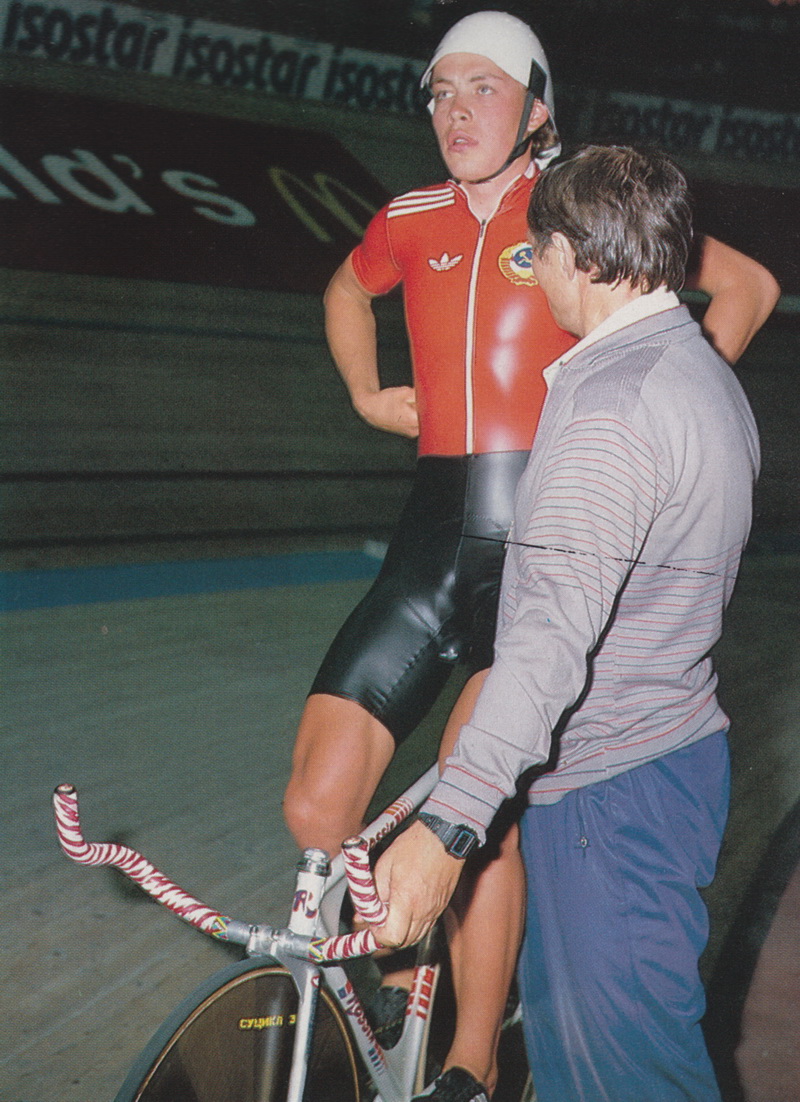
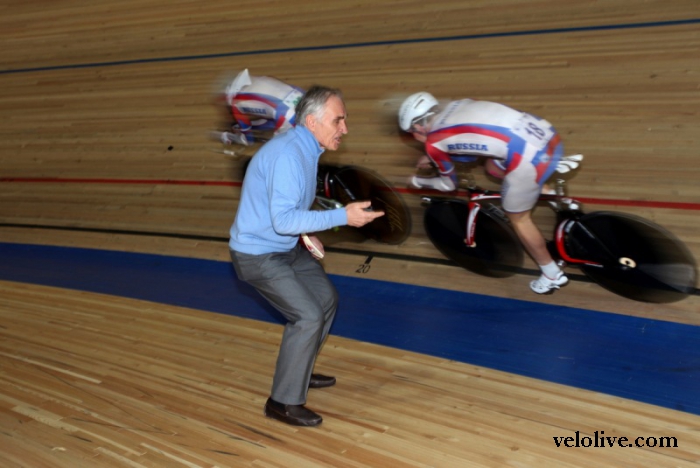
Kuznetsov holding up Eki, who is sporting a lovely rubber skinsuit.
Viatcheslav Ekimov began training with Kuznetsov at the Lokomotiv school at the age of 12 and as the years went on, Ekimov became the gem of the school and in 1984, he won junior World Championship titles in the team pursuit and the points race. This kicked off a 7-year stretch where Ekimov won either a World Championship or an Olympic title. Kuznetsov, who was outside the Soviet National Team for the early part of his career, was brought in to head the Soviet National Cycling Team beginning in 1985, which was the year that Ekimov became a senior rider. This was a bit ironic in that for many years, Kuznetsov detested the National Team because they would take riders and you never knew exactly when they would be returning and in what sort of shape.

The racing was the easiest part of a Soviet rider's life. The training that Kuznetsov prescribed was ruthless. While younger riders just rode a couple of hours a day for 5 or so days a week, riders heading into the later junior ranks were thrown to the wolves and faced as many as 4 training sessions in a day. A ride before breakfast, a training session after breakfast, a training session after lunch and then a training session before dinner. This could happen daily no matter where you were at, be it in Leningrad or Dushanbe. Kuznetsov detested laziness and riders not living up to their potential. Injuries were one matter and could be understood but there would be no babysitting those that lacked motivation. It was either 100% or you were out of the program. There were stories of the staff getting the bikes out during layovers on transcontinental flights from Russia, where it was sub zero, to South America, where it was over 100F, and doing 1 or 2 hour full-gas training sessions before getting on the next flight. Riders like Ekimov thrived under this system (Ekimov kept Kuznetsov as his coach throughout his career) while others such as Evgeni Berzin began to rebel and were restless in a system "where you were not taught to think." Peter Post, who was known for his dictatorial style as a director and was Ekimov's first trade team director on Panasonic, was said to have deeply admired Kuznetsov.

Berzin and Vladislav Bobrik tried to leave the national team during the 1990 Tour Dupont in America after Bobrik led the race for 8 days but the pair were stopped. Post wanted to hire Berzin for '91 but the Soviets denied the transfer. Berzin was able to transfer to a Italian amateur team but had to pay half his meager salary to Kuznetsov and was called back mid-season. Berzin was able to escape the clutches of Kuznetsov and rode for the military team, CSKA Moscow, in '92 before transitioning to Italy. Berzin was a shoe-in for the Unified Team for the 1992 Barcelona but was blocked by Kuznetsov. The relationship was permanently severed.

Berzin did not mince words when he talked about his former coach. "I hate Kuznetsov. He is an old, straight Communist who tolerates no contradiction. In his school, we were nothing. We were isolated from the outside world. Watching television was taboo. You could not even talk to women...We did everything wrong, he did not."

While his style might have been too dictitorial and micro-managing for some, the results still came in. They won the Team Pursuit Gold Medal in 1988 in Seoul with Ekimov and wunderkind Dimitry Nelyubin, who was still a junior, along with three Lithuanians. Nelyubin, whose father, Vladimir, was one of the first Soviets to take on other Europeans outside of the Eastern Bloc, won the '89 Junior Worlds in the Pursuit and Team Pursuit. Berzin won the '90 Amateur World Championship in the Pursuit and the Soviets won the Team Pursuit. The track riders were exploding on the road with Ekimov winning the Vuelta a Tachira, Regio Tour, Tour de Normandie and three stages of the amateur Tour of Belgium in '88 while Nelyubin won the Tour of Belgium in '90 and others brought in a slew of stage wins.

Once Alfa Lum came in 1990, it was hard to keep riders. The collapse of the Soviet system saw the structure that Kuznetsov relied on disappear. No money. Riders and many coaches fled west. Kuznetsov led the Unified Team in 1992 but without any support, he had to look to the future. While remaining in St. Petersburg (having been renamed after the fall of communism) to keep his Lokosphinx club together, Kuznetsov had to move his winter training program after the team's base in Dushanbe collapsed after the fall. Thanks to Ekimov's original Panasonic contract, the club had some money to move to Mallorca but the island made things difficult and thanks to some contacts, they settled on an old poultry farm in Tortosa, Spain with roughly 10 to 25 thousand chickens. They converted the old chicken coops to hotel rooms and created a base that is still in use to this day. For the kids still in school, they would fly in teachers so that riders were able to train and study without stop.

While keeping operation going, Kuznetsov focused on the Atlanta Olympics with the team that included his son Nikolai and another young wunderkind in Alexei Markov. The 4-a-day training still persisted and in Atlanta, the first Russian Olympic team produced a silver medal.

While the Spanish operation was necessary as a warm weather base, Kuznetsov was constantly on the brink of personal financial ruin with the family nearing a point when Svetlana was an early teen where they began to question pulling out of tennis because it was too expensive. Svetlana started to win money thus it was a moot point and Kuznetsov got some breaks with some money backers but he was left in the cold twice.

In 2001, Kuznetsov got 1.5 million dollars for the new 2nd-tier Itera team, which was bankrolled by former cyclist Igor Makarov and organized in conjunction with the Russian cycling federation. Kuznetsov got some of the biggest talent including Pavel Brutt, Vladimir Karpets, Sergui Klimov, Alexei Markov, Alexander Serov and Kanstanstin Siutsou. It didn't even take two years before the project imploded due due to Makarov and the Russian Cycling Federation getting restless with Kuznetsov for not producing instant results. Kuznetsov told them five years before there would be a team that would be able to go into the Tour de France but after only two, Makarov and co. were looking elsewhere including a Belgian-Russian team piloted by the recently retired Andrei Tchmil, which never got off the ground.

The Student and the Master, Ekimov and Kuznetsov
Following Itera's implosion, Kuznetsov kept basically the same team while going back to basics. For the next three years, the Lokomotiv team continued to be based around Kuznetsov's famous St. Petersburg school. In 2003, the team won the Moscow World Cup Team Pursuit with Alexei Markov being the star of the team with a slew of results in the Iberian peninsula.

While Ekimov was going through the last stages of his career, Mikhail Ignatiev was just beginning his and was coming into the sport with as much hype as Ekimov. Ignatiev, under the tutelage of Kuznetsov, won the 2002 and 2003 Junior World Time Trial and possessed 4 Junior World Titles on the track. Still a junior, Ignatiev won the points race in the Sydney World Cup. Less than a year later at just 19, Iggy won the 2004 Olympic Points Race after lapping the pack 4 times to hold off Joan Llaneras. Kuznetsov, along with Ekimov getting the silver in the time trial, was back once again on the Olympic level. Ignatiev would dominate the Points Race on an international level for the next few years but would never again see the heights of his early youth.

Kuznetsov ran Lokomotiv through 2005 when a former student who had abandon the bike for business came to him with a proposition. Oleg Tinkov had made a fortune off beer after a pretty good junior career was stalled after his military service. He joined Kuznetsov in 2006 to form Tinkoff Restaurants, a tam of just 12 riders including one in Tinkov himself. The team itself was full of talent in Ignatiev, Nikolai Trusov, Alexander Serov, Pavel Brutt along with wunderkind Ivan Rovny. The aging Kuznetsov was played hard though and even after a successful year, Tinkov took 9 out of 11 riders (not including himself) from the Tinkoff Restaurants team to form Tinkoff Credit Systems while giving Kuznetsov the middle finger and taking all of the riders he had developed.

So what does a man nearing 70 do when a bat-shit crazy ex-rider takes away your riders? That's right, build a velodrome. Kuznetsov went back to Lokosphinx in St. Petersburg as the club was facing financial ruin at points but after her 2004 US Open win, Svetlana gave her father 1 million dollars to help finance the building of the Lokosphinx Cycle Sport Center while he got enough bank loans that he will be paying them off for the rest of his life. Kuznetsov was able to building a proper 250 meter track in St. Petersburg for the first time in his coaching career and even while he is at the end of his coaching days, the old man still works like a dog.

Still going at nearly 75 year old
During the past few years while away from the velodrome, Kuznetsov has managed the Lokosphinx continental team that races primarily in Spain but does get out to South America but does get out to other spots in Europe. He is currently developing riders such as Evgeny Shalunov, Kiril Sveshnikov, Sergey Shilov, the Vdovin brothers and Aleksey Rybalkin. Though I think Kuznetsov needs to teach them a few manners...


Alexander Kuznetsov was a cornerstone to the late Soviet sports system, especially since he was not in the proper national system. Kuznetsov's school made western riders cramp up just by the thought of having to do a team pursuit against the like of Ekimov, Nelyubin, Manakov, Krasnov, etc. If it was not for Alexander Kuznetsov, there would be no Viatcheslav Ekimov as we knew him. No Evgeni Berzin winning the Amateur World Championship in the pursuit. No Mikhail Ignatiev coming right out of the junior ranks to win an Olympic Gold. Kuznetsov was no fun loving coach. He made riders forget the pain and push to new levels. His work is still being felt and appreciated by many riders in the Russian system, especially since a proper 250 meter velodrome is in St. Petersburg thanks to him.

This is not an article to speculate about whether or not he doped any of his riders. He very may well have or maybe did not. I do not have any evidence of Kuznetsov carrying out some elaborate doping system. He wasn't perfect by any means but you cannot argue with results. Alexander Kuznetsov is a big reason Russian cycling got a fearsome reputation for riders that would dig tooth and nail as if they had nothing left to live for. His coaching career has spanned around 50 years and he has gained 7 Olympic Gold Medals and over 40 World Championships with his riders.

Yet if you were to go to his home, you would not see any medals or trophies on the walls. He doesn't care for large banquets or noisy feasts. He is a man of few pleasures and has no money savings to speak of as nearly every penny he has made has gone back into his riders, his club and into the development of cycling in St. Petersburg.

In the age of big egos, Kuznetsov is bit of an enigma and while there are many unanswered questions about his programs, his drive and relentless pursuit of development is certainly something that many could learn from.

Saturday, June 6, 2015

Giro della Valle d'Aosta route unveiled

The 2nd largest and perhaps the overall toughest U23 stage race, the Giro Ciclistico della Valle d'Aosta, has unveiled their route for the 52nd edition of the race and while the race still includes a bit in France due to some funding obligations, they have pushed the race to a new level that it hasn't seen in the past few years. If any guys that happen to be reading this and are planning to race this next month, you better go on a nice long training camp to get ready for this. No bread. No sex. Water and vegetables for the next month and a half. Even then, you will be mouth agape somewhere in the remote Aosta Valley wondering why the hell you had that one night 13 days ago where you splurged with that cookie after training. Animal.

The first two stages of the race take place around the town of Morillon, which is nestled in the Haute Savoie region of France. There is historical connection with the Aosta Valley and the Savoie region as the Aosta Valley was under the reign of the Duchy of Savoy and then the First French Empire but joined the Kingdom of Italy in 1861. The Aosta Valley was and still is a tri-lingual place with over 50% of the population knowing Italian, French and Valdotian, which is a dialect of the Arpitan language that is pretty exclusive to the Alps region. The Aosta Valley was put under a forced Italianization program by Mussolini with outside Italians moving into the region, which saw many of the native Valdostans emigrate to France and Switzerland. The Aosta Valley now has semi-autonomous status inside Italy meaning that they get more freedom in terms of governance but must finance school systems, health care and most public infrastructure on their own. While they are the smallest and least populated region of Italy, they have a big tourism sector that doesn't have them hurting for money.

Anyways...back to the race.

The first two stages take place in Haute Savoie and this is primarily because of a financial dependency rather than any historical significance. The race was perilously close to kicking the bucket a few years ago but was saved when their partnered with the Haute Savoie community, specifically the cities of Châtel and Morillon.


The Prologue is an uphill time trial that is identical to the final time trial from last year's race, which was won by Ildar Arslanov. Starting in Morillon, the race goes straight uphill for 367 meters over a 5.4 kilometer course, which makes for an average gradient of nearly 7% and a max of over 11%.

Stage 1

The stage will start in Morillon and consist of two loops. The first loop will see the peloton have a fairly easy start before tackling the category 2 climb at La Frasse, which is 8 kilometers in length and features a hard first bit with a max gradient of 13% before leveling off to see an average of around 5.5%. The peloton will descend back into Morillon to tackle the climb to Les Esserts but the official climb summits at Pont de Nantafon, which is 200 meters above the Les Esserts point. The race descends back into Morillon and the racers will get a lull before the long but fairly steady Col de Pleine Joux. Once the race descends this, they will only get a brief respite before heading up the Col de la Ramaz, which averages nearly 7.5% with a max gradient of 13.5%. Hows that sound for an opening stage?

After the summit of the Ramaz, the race plunges back down into the valley but once back into Morillon, the race must once again go up to Les Esserts, which would be the 3rd time in two days. Last year, Dylan Teuns attacked in the final kilometer to take a stage win after following nearly an identical route for the 2nd half of the stage.

Stage 2 Courmayeur to Pont-Saint-Martin

Stage 2 will finally touch back onto Italian soil with the race kicking off from Courmayeur, which sits at the foot of Mont Blanc. The first 50 kilometers are relatively tame, minus one climb, but the beast of the stage is the climb to Clemensod, which follows the Saint-Barthélemy valley. The climb is 18 kilometers and can get steep in parts with a max of 13% but it flattens out for portions and only averages 5.5% for the entire climb.

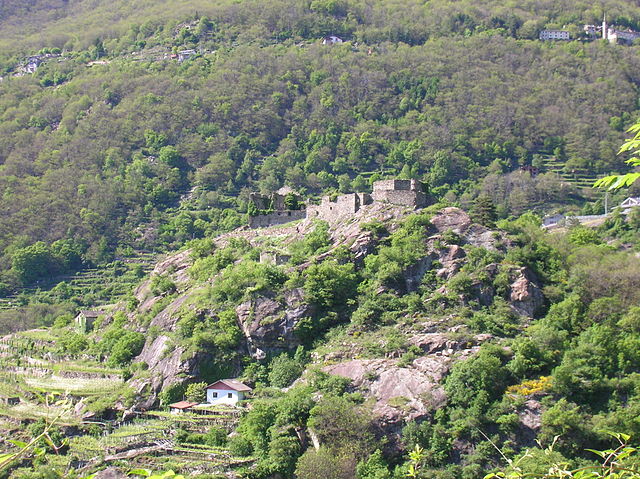
Ruins at Pont Saint-Martin

With no relief being in order for the 152 kilometer day, once the race is off the Clemensod climb, they turn right back around and summit the short but leg-zapping Verrayes climb. The last true difficulty will be the Col d'Arlaz, which climbs for 7.3 kilometers and the hardest part happening in the middle before leveling off at the top.  The short bump at Perloz might benefit an attacking rider down on GC or just shed a few more before a small group sprint into the finish town of Pont Saint-Martin, which has some castle ruins.

Stage 3  Gressan to Valtournenche (Breuil Cervinia)

Starting from Gressan, the race includes 4 climbs and summits at 2004 meters after climbing for 25 kilometers on Breuil Cervinia.

It is weird to say that the Les Fleurs climb, which is 11.5 kilometers and averages 7% gradient, is probably the easiest climb on tap for the riders because it is still early and most will be saving their powder for the next climb. The Col Tze Core is quite the rural and brutal climb that was last used in this race in 2013 but was used as an early climb. At a distance of 16 kilometers, the Tze Core averages 7.6% and hits a gradient of over 15% at one point. Head to Cycling Challenge for Will's take on the climb.

After the descent back down to the valley into Chatillon, the race finishes with 25 kilometers of uphill to the summit. This finish was used last year on stage 1 where Manuele Senni took the win but it didn't include the entire climb and didn't have as brutal of run-up as this stage.

After over 4000 meters of climbing on the stage, the GC winner will most likely be decided on this stage or at the very least, put enough time in to make themselves the favorite.

Stage 4 Pollein to Saint Christophe

After a huge mountains stage, what is the next logical thought for a stage? You are right. An annoying stage with 8 classified climbs and an unclassified uphill run-up to the finish at Saint-Christophe. Looking at a map, the start and finish are just a couple kilometers aware from one another and the stage runs along a valley and makes some deviations to hit the climbs.

For the 3rd time in the race, the Col d'Introd will be used. The course doesn't go more than 20 kilometers, give or take, between climbs. This could be a day for a breakaway to take a win but for attentive GC riders, they will be able to strike on the final run-up to the finish as it is pretty steep and could catch some people out.

Stage 5 Pre Saint Didier to Col du Grand Saint Bernard

This is the granddaddy of them all. In what looks to be the best Giro della Valle d'Aosta in a few years, the race is finishing with a short but brutal stage with two climbs that 32 kilometers in length over a course that is just 86 kilometers. It is mainly flat to downhill for the first 15 kilometers before heading uphill on a stair step climb to Verrogne, which nearly 15 kilometers with an average of just 5.5% but a maximum gradient of over 15%.

Grand St. Bernard summit with the famous Hospice towards the rear (Wikipedia)

A stair step descent is a brief respite as the race has just a couple of kilometers of flat racing before it begins to go up hill for the final 33 kilometers. The first part of the Colle del Gran San Bernardo is fairly steady and the climb levels off but kicks back up for 17 kilometers of steady climbing up to the finish at nearly 2500 meters. Will from Cycling Challenge has you covered on this climb as well too.

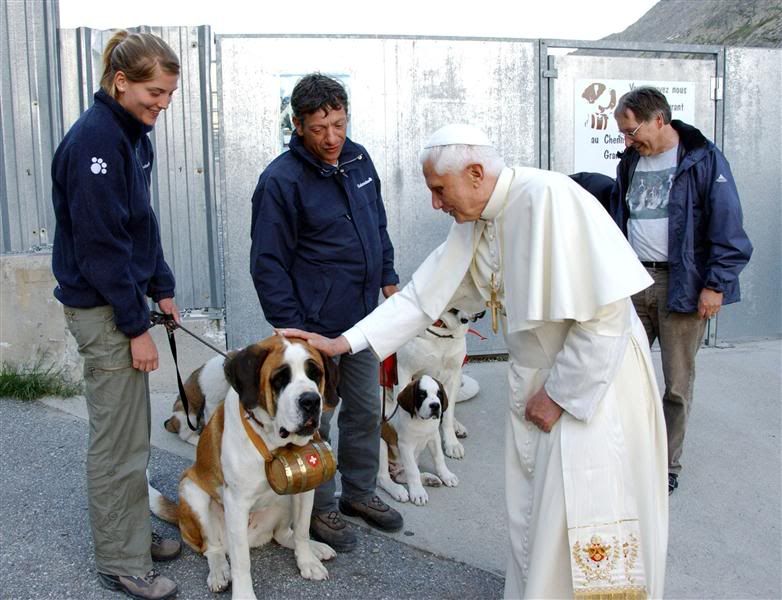
A brutal way to end off a tough race but they really should give the winner of this stage a St. Bernard puppy. The pups date back to the beginning of the 18th century from the Hospice St. Bernard that sits at the summit of the climb and were bred their as well.

Yes, you may pet me your Pope-ness (Wikipedia)
For the whole breakdown of the race, head to the race website or see the full race book for more details. In any case, this race looks to be back to some of its former strengths and I am looking very forward to it, even if someone makes it a blow out.

Wednesday, June 3, 2015

U23 World Championships Qualifying as of 6/2/15

So the U23 World Championships in Richmond are just a few months away and the race for UCI points to qualify is on. With the U23 Peace Race and the Paris-Roubaix Espoirs finished, I think it is a good time to look and see who has enough to get to Richmond right now.

The document from the UCI that explains the qualifying procedure can be found here. Each continental ranking has a different breakdown of how their countries qualify and the number of riders they receive. Just because a country technically qualifies for the race doesn't mean you will see them on the start line.

Oceania

Australia and New Zealand are basically guaranteed riders every year. That is until Fiji gets their big break.

5 riders - New Zealand

3 riders - Australia

Africa

The standard countries from here. I'm not sure if Africa gets their continental champion added since it isn't on the U23 Nations Cup calendar but if so, South Africa will get another spot as Jayde Julius was the first U23 across the line.

5 riders - Algeria

4 riders - Ertirea

3 riders - Morocco, South Africa and Rwanda

America

Currently the USA is on the 4 rider mark but being the organizing nation, they get an automatic 5 starters. Also, Colombia has the current Continental Champion and therefore that rider, Jhonathan Restrepo, will start in addition to the other riders.

6 riders- Colombia

5 riders - Chile, Argentina, USA

4 riders - Mexico, Ecuador

3 riders - Canada, Brazil, Venezuela

Asia

The nations with 1 rider are those that currently have a U23 rider in the top 100 of the Elite Men UCI Asia Tour. They will get to start 1 rider for the road race. Also, Japan has the current Continental Champion and therefore that rider, Yuma Koishi, will start in addition to the other riders.

6 riders - Japan

5 riders - Iran

4 riders - Kazakhstan, Hong Kong

3 riders - South Korea, Taiwan, Uzbekistan

1 rider - Indonesia, Kuwait, China, Philippines, Malaysia

Europe

It is hard to miss the World Road Race if you are a European nation. Unless you have no riders in the U23 field then you can probably qualify for at least one rider. Nations that are outside of the qualifying wall include Finland, Lithuania, Luxembourg, Croatia, Serbia, Greece...and some other small nations.

Also, you get an extra rider if you are a top 5 team in the UCI Nations Cup by August 15th. Currently all of those nations are in Europe.

6 riders - Norway, Denmark, France, Italy and Great Britain

5 riders - Netherlands, Germany, Belgium, Austria, Russia, Turkey, Switzerland, Slovakia, Belarus, Sweden

4 riders - Spain, Czech Republic, Axerbaijan, Portugal, Poland

3 riders - Cyprus, Slovenia, Estonia, Ukraine, Ireland, Albania, Latvia

Of course, these are subject to change especially with many summer races coming up that could see some smaller nations get some point boost but this could be a close template.

Tuesday, June 2, 2015

Paris-Roubaix Espoirs: Spengler stays upright in the muck and mire

To put it lightly, the 2015 Paris-Roubaix Espoirs was a total shitstorm that had riders crashing and flatting all over the place and many just struggled to get to the Roubaix velodrome. It was a race where just finishing could make a line on a rider's resume and saw early race favorite not even sniff the front of the field.

The race began under gloomy weather and the first abandon happened within the first 10 kilometers when Axel Guilcher (Sojasun Espoirs) crashed hard. Pierre Idjouadienne (CC Etupes) was the first attacker of the race but after a brief period solo, he was joined by Nico Denz (Chambery CF), Steven Lammertink (SEG Racing) and Cedric Defreyne (BCV Works-Soenens). Joan Tenbrock (Stolting) powered himself up to the breakaway and within 20 kilometers, he made it up to the quartet.

The problems behind had already begun. Riders such as Nathan Van Hooydonck, Oliveira Troia, Yannick Eckmann, Senne Leysen and many more has crashes and were forced to abandon. Rayane Bouhanni (AWT Greenway) had a hard fall and was forced out early on.

Bouhanni in the ditch (via directvelo)
Martijn Budding (Rabobank) and Ricardo Van Dongen (SEG Racing) joined up with the break but not before both Lammertink was distanced by a mechanical and Defreyne...well he couldn't hold the pace. The deck was constantly being shuffled but after the gap was perilously close, the break was neutralized with 69 kilometers to go.

The race itself was still a shit show. New Zealand U23 Champ Hamish Schreuers broke his wrist. Tao Geoghegan Hart crashed 4 times and Logan Owen had a hell of a day that didn't allow him to go for another Roubaix top 10. After the breakaway was caught, riders including Van Hooydonck, Enzo Wouters, Damien Touze, Rob Leemans and Ruben Pols all either crashed or suffered mechanicals. It was literally survive to advance.

While the skating show continued, Hugo Hofstetter (CC Etupes) got out front alone for a time. After roughly 10 kilometers of freedom, Hofstetter was caught but a breakaway of three emerged that would shape the race. Martin Grøn (Riwal) along with Bas Tietema & Lukas Spengler (Both BMC Development) got away together and over the next 15 kilometers, they got a gap of nearly one minute on the chasing peloton.

With 25 kilometers to go, former Ronde van Vlaanderen Juniors winner Jenthe Biermans (SEG Racing) got away from the peloton in search of the leading trio. While Biermans chased, the trio had exploded. Tietema and Grøn were involved in some sort of crash and Spengler was left along in the lead and was continuing to pound the pedals. While Biermans was getting closer, he too encountered a mechanical issue and was forced to drop back.

Then came Carrefour de l'Arbe where apparentl Thery Schir bridged up to Spengler but within kilometers, he was distanced off the back. It was the last time that anyone would see Spengler until the velodrome.


PARIS-ROUBAIX ESPOIRS by JMGUIDEZ


Behind, it was the Biermans who took a convincing sprint for 2nd place ahead of Hofstetter and former French junior champ Felix Pouilly. Big favorites Maxime Farazijn and Davide Martinelli came in 5th and 6th while other powerhouse riders such as Thery Schir, Stan Godrie and Bas Tietema all came inside the top 10.

Make no mistake, this was an insane day of racing. Kudos to all that were able to even make it to the line and those that even tried.

Other thoughts...

-BMC Development had a masterful race. They seemingly always had someone in a move or had numbers. They had 2 out of the three in the race defining move and even after a crash, they had numbers in the chasing group. They finished with 3 in top 10 and a beautiful win. Geert Van Bondt and his boys can read a race.

-In 7th place was Jimmy Duquennoy (Color Code). He gets the medal for being anonymous, surviving and getting a damn good result.

-Lukas Spengler is the first Swiss rider to ever with the Paris-Roubaix Espoirs and first Swiss rider to hit the podium since Laurent Beuret in 2008.

-Pierre Idjouadienne, the first attacker of the race, was the last rider to officially finish at 19'47" down on Spengler. I say officially since there were 11 riders out of the time cut that came across including strong riders such as Dan Eaton (USA), Corentin Ermenault (CC Nogent-sur-Oise) and Robert-Jon McCarthy (SEG Racing).

-Very good photos by Bede Geoghegan Hart from the race. Mainly focused on Axeon but some good race shots as well.